







 HR & Safety Software
  ISO Training Academy
  foundU Client Login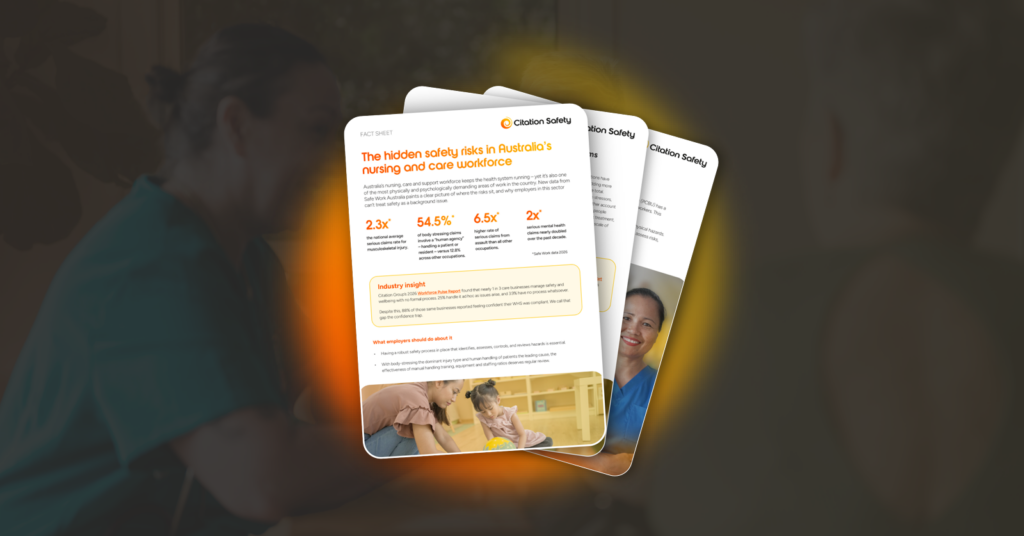

Guides
The hidden safety risks in Australia’s nursing and care workforce
Nursing and care workers keep Australia’s health system running, and the work asks a lot...
7 October, 2026
 Blogs
2 March, 2024
Blogs
2 March, 2024

According to the Australian Bureau of Statistics Work-Related Injuries Survey, more than 560,000 people had a work-related injury or disease in the 2017–18 financial year.
From a global perspective, a worker dies from a work-related accident and 153 workers experience a work-related injury every 15 seconds.
These numbers have a devastating impact on businesses and society as a whole — but with effective processes in place, these incidents can be prevented.
ISO 45001 (occupational health and safety management) helps organisations of all sizes and industries to develop a safer working environment for all employees. The aim of the standard is to reduce workplace injuries, deaths and diseases through robust safety management systems and processes.
Here, we share three examples of how this standard can improve the safety of your workplace — but first, let’s take a closer look at ISO 45001.
Work-related accidents are a traumatic experience for the victim and your team as a whole. But from a business perspective, there is also a huge range of other consequences to contend with.
The direct and indirect costs of work-related accidents and illnesses sit at around $3.8 trillion AUD worldwide. Former Chair of Project Committee ISO/PC 283 Occupational Health and Safety Management Systems, David Smith, had this to say on the matter:
“Apart from the devastating impact on people, poor OHS management can have many negative effects on organisations such as the loss of key employees, business interruption, claims, insurance premiums, regulatory action, reputational damage, loss of investors and, ultimately, the loss of business,” David says.
“Businesses need to ensure they manage all their risks to survive and to thrive. OHS is a key aspect, which every business has to manage proactively.”
ISO 45001 offers a simple Plan-Do-Check-Act model to help organisations plan what needs to happen to minimise the risk of harm on and offsite. Your OHS system should address concerns that lead to long-term health issues and absence from work as well as those that cause accidents.
We covered the Plan-Do-Check-Act model in a recent article. Essentially, this model allows you to quickly and easily review your OHS management system, monitor its effectiveness, identify potential gaps in the system and provide new opportunities for improvement.
Regular audits using the Plan-Do-Act-Check model can help reduce work-related incidents both on and off-site. This can have a positive impact on workplace safety, productivity, team morale and more.
Through the Plan-Do-Check-Act model, you will be able to identify potential hazards in the workplace and create firm processes to minimise the risk of injuries, illnesses and deaths on or offsite.
The ISO45001 standard takes a risk-based approach to workplace health and safety i.e. you can identify and address potential risks before accidents even happen.
This process, in itself, offers a wide range of benefits for your business:
Think of the Plan-Do-Check-Act framework as your “early warning system” for potential risks, so you can prevent accidents rather than react to them.
Identification of OHS risks and opportunities is the first step in the process. The next step is to analyse the associated impacts to identify and take appropriate actions to minimise risks, eliminate hazards or correct gaps in the system.
ISO 45001, like all ISO standards, is about continual analysis and improvement. Addressing the “check” and “act” stages of the Plan-Do-Check-Act model can further minimise risks and make your workplace a safer, more efficient space.
Here are some potential questions you and your team can cover off during the review or analysis stage:
Consider reviewing your OHS system and processes quarterly, bi-annually or annually. This will help keep on top of process improvements and workplace safety.
As your OHS system and processes improve, your team members will require additional training to get up to speed. This training will not only improve your team’s skill set, but their new and improved knowledge will allow them to work safer on and offsite.
Thanks to improved processes and training, your team members will feel more confident in their individual roles, be more mindful of best practices and take responsibility for their own safety (as well as the safety of their coworkers).

Nursing and care workers keep Australia’s health system running, and the work asks a lot...

Labour shortages. Multiple contractors and subcontractors. Tight deadlines. Client expectations. Compliance obligations across several sites...


Structured onboarding, a deliberate first 90 days rather than a pile of paperwork, is one...


“What we often see is businesses feel confident because they have HR policies or an...