





 HR & Safety Software
  ISO Training Academy
  foundU Client Login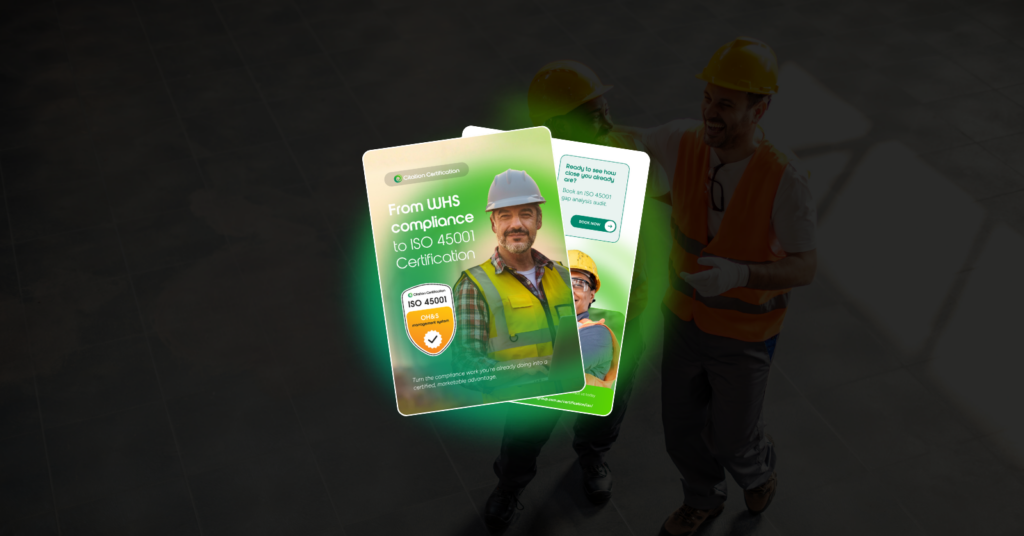

Guides
From WHS compliance to ISO 45001 certification
You already run risk assessments, keep a legislative register, investigate incidents and hold training records....
22 September, 2026
Blogs
14 March, 2024

In today’s complex business environment, organisations are continuously seeking ways to streamline their processes and enhance efficiencies. One proven approach is through an Integrated Management System (IMS). At Citation Certification, we specialise in offering tailored certifications across various standards, including ISO 9001, ISO 45001, ISO 14001 and more, to help businesses achieve excellence and continuous improvement.
An Integrated Management System (IMS) combines all aspects of an organisation’s systems and processes into one complete framework, enabling an organisation to work as a single unit with unified objectives. This approach not only includes quality management systems and environmental management systems but also extends to occupational health and safety management, among others.
When these systems are integrated rather than siloed, they promote increased efficiencies and a culture of continuous improvement. By implementing an IMS, companies can avoid duplication, reduce costs, and optimise their operational performance, all while ensuring compliance with international standards.
Achieving certification in Integrated Management Systems from Citation Certification offers numerous benefits:
At Citation Certification, we understand the importance of a tailored certification process that aligns with your company’s specific needs. Our approach to integrated management system certification is designed to be as efficient and seamless as possible, providing support throughout the entire certification journey.
Our experts specialise in the integration of management systems, ensuring that your IMS is effectively implemented and maintained. With our help, your business can align with international standards, like ISO 45001 for occupational health and safety, and pursue excellence in every facet of operation.
Achieving IMS certification involves a clear, step-by-step process:
Our team will help you understand the specific requirements for integrating your management systems into a single system that meets international standards.
Identifying the gaps in your current processes is a crucial part of the certification journey. Performing a gap analysis is the best way to improve and document your processes to align with ISO 9001 standards before an external audit is conducted.
We guide you through implementing your integrated management system, ensuring every part of your organisation is aligned with the system’s objectives.
Certification audits consists of two stages; stage one involves evaluating the documentation of your management system, while stage two checks if the standard requirements have been implemented.
After successfully achieving certification, you will receive a ‘Statement of Certification’ confirming compliance with the relevant standard. This remains valid for three years, with regular annual surveillance audits to maintain compliance.
Being IMS certified means your management system has been evaluated and meets the requirements for quality, safety, and environmental management standards within a unified system.
IMS refers to the integration of multiple management system standards into one unified framework. ISO refers to the International Organisation for Standardisation, which develops and publishes a wide range of proprietary, industrial, and commercial standards.
To get IMS certified, your organisation needs to integrate its management systems into a coherent framework that complies with the standards of the required ISOs. You then need to undergo an audit by a certified body like Citation Certification to confirm compliance and effectiveness of the IMS.

You already run risk assessments, keep a legislative register, investigate incidents and hold training records....

A system works when it’s smooth, easy to navigate, and transparent.