







 HR & Safety Software
  ISO Training Academy
  foundU Client Login

Loved working with the auditors for our ISO Accreditation. They provided me with valuable feedback and observations that will certainly enhance the business. I felt very well supported during this process as it was my first audit experience.


Being ISO 9001 compliant means your quality management system meets all the requirements of ISO 9001:2015, which is the only standard in the ISO 9001 series against which you can be certified.
In practice, that means identifying the external and internal factors affecting your ability to deliver quality products or services. It means understanding what your relevant interested parties need and establishing a quality policy and quality objectives aligned to your strategic direction.
It also means putting documented controls across your existing processes, using risk based thinking and risk-based thinking to identify and address risks and opportunities, and creating systems for performance evaluation, internal audits, and management review.
Staying ISO 9001 compliant means committing to continual improvement – acting on corrective actions and refining your approach as a structured, measurable practice. ISO 9001 compliance is an ongoing discipline, not a one-time event.

It’s a question we get often, and the distinction matters.
For most Australian businesses, certification is the goal. It’s what gives your compliance credibility with customers, government bodies, and supply chain partners. In sectors like construction, manufacturing, and defence, meeting ISO 9001 requirements is often a supplier condition, not just a way to streamline operations and gain competitive advantage.
The next step is ISO 9001 certification – independent verification from an accredited body that your compliance is real.
ISO 9001:2015 is the only standard in the ISO management system standards family specifically focused on quality management. It sets out ten clauses of ISO 9001 compliance requirements from Clause 4 onwards, built on the Plan-Do-Check-Act (PDCA) cycle. The gap analysis at the start of the process tells you exactly where you stand.








ISO 9001 is built on seven quality management principles that run through every requirement in the standard. They explain why the standard is structured the way it is and why a compliant QMS changes how your business operates, not just what it documents.
ISO 9001 compliance isn’t just about passing an audit. A compliant QMS delivers competitive advantage, cost savings, enhanced credibility and customer trust, and the ability to meet customer expectations consistently, well before your certificate is issued.




Your Citation Group auditor reviews documented information at your certification audit to verify your ISO 9001 compliance is genuine, not just claimed. The certification process runs across two stages: a Stage one documentation review, then a Stage two on-site assessment.
The evidence your auditor looks for typically includes your quality policy and objectives, QMS scope, risk management records, process documentation, internal audit findings and corrective actions, customer satisfaction data, and management review records. This is also how you demonstrate compliance with regulatory compliance obligations.
Most businesses already have a significant portion of this in place. The gap analysis gives you practical guidance on exactly what exists and what needs to be built – before you commit to anything.

At Citation Group, you’re assigned a named auditor from day one – the same person from your gap analysis through to certification and beyond. No rotating teams, no starting from scratch.
We’re a JAS-ANZ accredited independent certification body. Our ISO 9001 certificates carry national and international recognition, accepted for government tenders, supply chain requirements, and regulatory compliance purposes across Australia. When you work with us, you also get:
With the right certification body alongside you, ISO 9001 compliance is a process that makes your business genuinely better, not just certified.
Loved working with the auditors for our ISO Accreditation. They provided me with valuable feedback and observations that will certainly enhance the business. I felt very well supported during this process as it was my first audit experience.

Thank you for working with us to obtain ISO 45001 Certification. The process was thorough, structured and efficient and the system enhancements we have made to achieve certification will benefit our company greatly.
The breadth of experience and technical expertise you brought to the process was invaluable and really appreciated by all the senior leadership team involved.

The collaborative relationship we’ve developed with Citation Certification has turned into a true partnership where our business needs are holistically understood and supported.

The auditor that was assigned to us was fantastic. He explained what was expected and required before the audit commenced. And even during the audit process, when things were being identified or uncovered, we could work quite dynamically. He was really accommodating and professional, and really quite pragmatic in the recommendations for improvement, which we’ve taken on board.

Our most recent audit cycle was one of the most positive experiences we’ve had since certifying to ISO/IEC 27001:2022, and the relaxed nature allowed us to engage in discourse that was open and honest about gaps and our plans to fix them.

Brittany Byrne recognised as a finalist in the Mentor of the Year category.
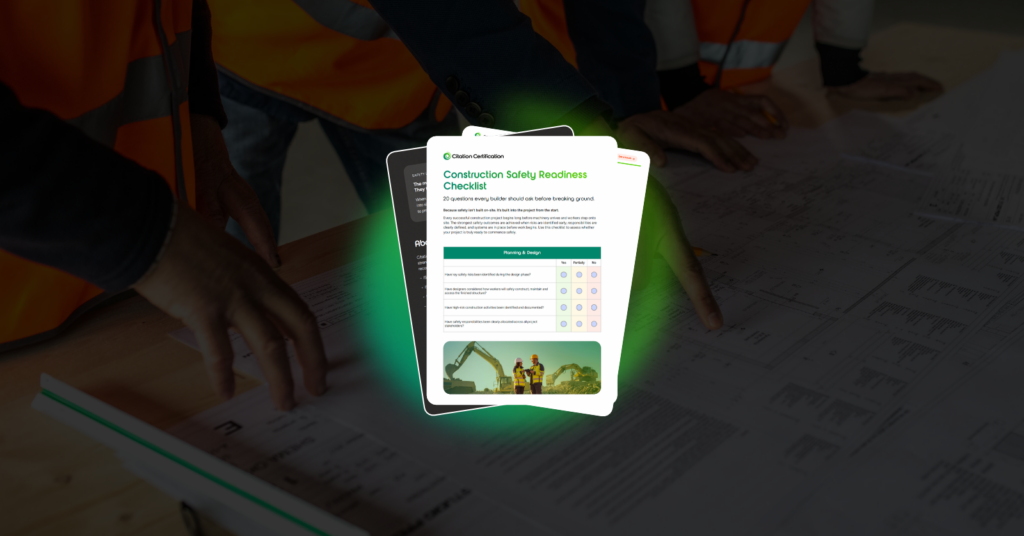
Safety isn’t built on site. It’s built into the project from the start — in...


Have your employees started submitting leave requests for December? Do your bar staff want to...


Nursing and care workers keep Australia’s health system running, and the work asks a lot...

Labour shortages. Multiple contractors and subcontractors. Tight deadlines. Client expectations. Compliance obligations across several sites...
ISO 9001 compliance means your quality management system meets all the requirements of ISO 9001:2015, the international standard for quality management. A compliant business has documented its processes, established quality objectives, identified and addressed risks, and put systems in place for continual improvement and performance evaluation. An ISO 9001 certification body independently verifies this through a formal audit of your documented evidence.
Compliance means your QMS meets the requirements of ISO 9001:2015. Certification is independent proof of that compliance, issued by a JAS-ANZ accredited certification body after a formal audit of your QMS. For Australian businesses seeking to demonstrate compliance to customers, government bodies, or supply chain partners, certification is the standard that carries commercial and regulatory weight.
ISO 9001 compliance requirements cover the full scope of your QMS. That means understanding your organisational context and the needs of interested parties, through to leadership commitment, risk based thinking, process controls, performance evaluation, and continual improvement.
The standard requires you to document processes, maintain documented information, and demonstrate that your QMS is operating effectively. Compliance with all requirements of ISO 9001:2015 is what your certification audit verifies, and what positions your business to achieve long term success.
You demonstrate ISO 9001 compliance through documented information – records and documents that show your quality management system is operating as intended. This includes your quality policy, quality objectives, internal audit records, corrective action records, management review records, and evidence of customer satisfaction monitoring. An accredited certification body reviews this evidence during your certification audit to verify that compliance is genuine.
In Australia, only a JAS-ANZ accredited independent certification body can issue ISO 9001 certification that carries genuine commercial and regulatory weight. JAS-ANZ accreditation confirms the certification body meets international standards for competence and impartiality. Your certificate is then recognised nationally and internationally through the IAF Multilateral Recognition Arrangement.
ISO 9001 has been revised several times since 1987, with updates in 1994, 2000, 2008, and most recently 2015. The next revision, ISO 9001:2026, is expected to be published in September 2026, following a consensus reached in August 2023 that updating the standard would add genuine value.
The 2026 revision is expected to sharpen the focus on risk management, digital transformation, and adaptability in modern business environments. It will also introduce climate change considerations, requiring businesses to assess whether climate-related factors are relevant to their QMS.
If you’re currently certified to ISO 9001:2015, or pursuing certification now, there’s no need to wait. Your QMS built on the current standard provides a strong foundation for transition, and Citation Group will support you through that process.
The main factors are your organisation’s size, number of locations, and QMS complexity. These determine your audit duration, which is where cost is calculated. It’s also worth thinking about the full three-year certification cycle, not just the initial audit. Head to our ISO 9001 certification pricing page or get in touch for more information.