







 HR & Safety Software
  ISO Training Academy
  foundU Client Login

Loved working with the auditors for our ISO Accreditation. They provided me with valuable feedback and observations that will certainly enhance the business. I felt very well supported during this process as it was my first audit experience.


ISO 45001 compliance means your organisation has implemented an occupational health and safety management system (OHSMS) that meets the requirements of ISO 45001:2018 – the international standard for occupational health and safety management. An OHSMS is a structured framework of policies, processes, and controls for identifying workplace hazards, managing safety risks, and protecting the physical and mental health of everyone your operations affect.
In practice, a compliant OHSMS requires you to systematically identify hazards, assess risks, implement a hierarchy of controls, conduct internal audits, and commit to continual improvement in occupational health and safety (OHS) performance. ISO 45001:2018 replaced OHSAS 18001 as the global safety standard in March 2018. If your business hasn’t completed that migration, your previous certification is no longer valid.
ISO 45001 takes a risk-based approach to OHS management. Rather than prescribing a fixed list of controls, the standard requires you to assess your specific workplace risks and implement appropriate measures based on those findings.









ISO 45001 compliance directly supports your obligations under the Work Health and Safety Act 2011 (Cth) and equivalent state and territory WHS legislation. The standard’s requirement for systematic hazard identification, risk assessment, worker consultation, and emergency preparedness aligns closely with your legal compliance obligations as a business operator.
ISO 45001 certification doesn’t replace your legal obligations. However, it gives you a robust, defensible framework for demonstrating that you’ve taken all reasonably practicable steps to keep your people safe. In the event of a workplace incident or regulatory investigation, certified compliance with an internationally recognised safety standard gives you a much stronger position.
ISO 45001 certification isn’t just about passing an audit. For Australian businesses, a certified OHSMS delivers measurable commercial, operational, and reputational benefits. Many of these benefits begin to emerge well before certification is formally achieved.





The terms are often used interchangeably. They shouldn’t be.
For most Australian businesses, certification is the goal. It’s what gives your compliance credibility with clients, government bodies, regulators, and supply chain partners. If you’re ready to move from self-assessed to independently verified, we can help.

Loved working with the auditors for our ISO Accreditation. They provided me with valuable feedback and observations that will certainly enhance the business. I felt very well supported during this process as it was my first audit experience.

Thank you for working with us to obtain ISO 45001 Certification. The process was thorough, structured and efficient and the system enhancements we have made to achieve certification will benefit our company greatly.
The breadth of experience and technical expertise you brought to the process was invaluable and really appreciated by all the senior leadership team involved.

The collaborative relationship we’ve developed with Citation Certification has turned into a true partnership where our business needs are holistically understood and supported.

The auditor that was assigned to us was fantastic. He explained what was expected and required before the audit commenced. And even during the audit process, when things were being identified or uncovered, we could work quite dynamically. He was really accommodating and professional, and really quite pragmatic in the recommendations for improvement, which we’ve taken on board.

Our most recent audit cycle was one of the most positive experiences we’ve had since certifying to ISO/IEC 27001:2022, and the relaxed nature allowed us to engage in discourse that was open and honest about gaps and our plans to fix them.
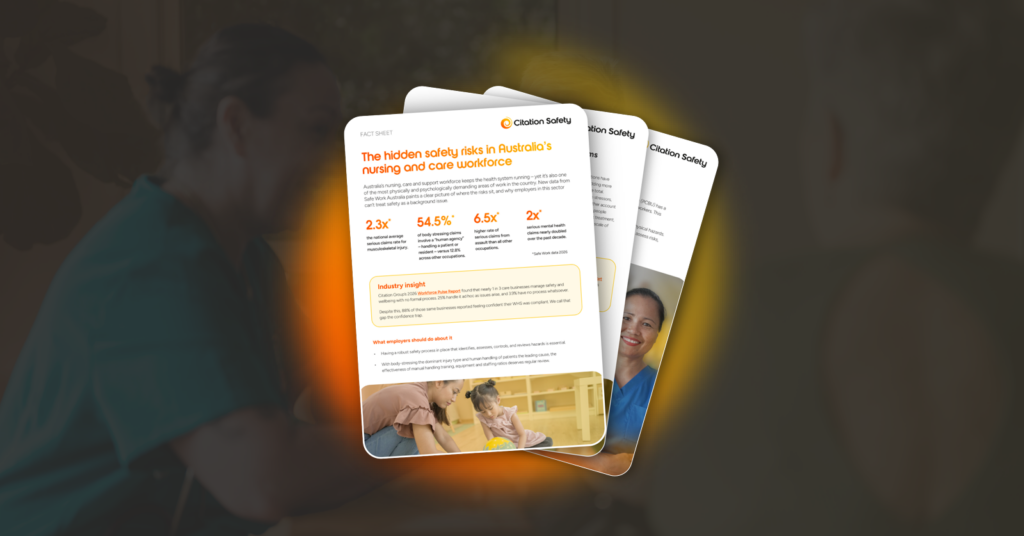

Nursing and care workers keep Australia’s health system running, and the work asks a lot...

Labour shortages. Multiple contractors and subcontractors. Tight deadlines. Client expectations. Compliance obligations across several sites...


Structured onboarding, a deliberate first 90 days rather than a pile of paperwork, is one...


“What we often see is businesses feel confident because they have HR policies or an...
ISO 45001 compliance means your organisation has implemented an OHSMS that meets the requirements of ISO 45001:2018 – the international standard for occupational health and safety management. A compliant system includes systematic hazard identification, a documented risk assessment methodology that involves meaningful worker participation, a hierarchy of controls for safety risks, emergency preparedness and response procedures, internal audits, management reviews, and ongoing corrective actions for continual improvement. ISO 45001 compliance is a systematic, risk-based approach, not a one-time exercise.
ISO 45001:2018 replaced OHSAS 18001 as the global safety standard for OH&S management systems, effective March 2018. OHSAS 18001 certification ceased to be valid after March 2021, and organisations had until September 2021 to migrate to ISO 45001. If your organisation hasn’t completed that migration, your previous certification is no longer recognised. Citation Group can guide you through the transition process.
ISO 45001 supports, but doesn’t replace, your legal obligations as a business operator under the Work Health and Safety Act 2011. The standard’s requirements for hazard identification, risk assessment, worker consultation, and emergency preparedness align closely with your statutory duties. ISO 45001 certification provides a structured, defensible framework for demonstrating that you have taken all reasonably practicable steps to ensure a genuinely safe working environment.
The time required depends on the size and complexity of your organisation, the current maturity of your safety practices, and the scope of your OHSMS. A gap analysis at the start of the ISO 45001 certification process gives you a clearer understanding of where you stand and what needs to be built. For many businesses, the process from initial gap analysis to achieving ISO 45001 compliance takes between six and twelve months. Working with an accredited certification body helps you move through the process efficiently.
ISO 45001 compliance is demonstrated through documented evidence. These records show that your OHSMS is operating effectively in practice, not just as designed. Your ISO 45001 certification body will look for evidence including your OHS policy and objectives, risk assessment records, internal audit findings, corrective action logs, management review records, worker consultation records, and training documentation. A stage one audit reviews your documentation before the full assessment, so you have the opportunity to address any gaps before the stage two on-site audit takes place.
If you’re not sure what evidence you currently have in place, an ISO 45001 gap analysis is the right starting point.
ISO 45001 exists to reduce work-related injuries, ill health, and fatalities. It achieves this by requiring a proactive and systematic approach to occupational health and safety management. Rather than responding to incidents after they occur, the standard requires you to identify hazards, assess risks, and implement controls before something goes wrong. Top management must demonstrate active leadership in safety, not just sign off on a policy. Workers must be consulted and engaged throughout. And the system must continually improve based on performance data, audit findings, and incident learnings. The result is a business that treats occupational health with the same rigour as financial performance – and can prove it.
ISO 45001 certification is relevant to any organisation with employees or contractors, but it carries the most commercial and regulatory weight in industries with elevated safety risk or strict supply chain requirements. In Australia, that includes construction, civil infrastructure, manufacturing, resources and mining, transport and logistics, healthcare, aged care, and government contracting. Many principal contractors now require it from subcontractors before they’ll let you on site. Even where it’s not formally mandated, it tells clients, insurers, and regulators that your approach to safety is serious and verifiable.