







 HR & Safety Software
  ISO Training Academy
  foundU Client Login

Loved working with the auditors for our ISO Accreditation. They provided me with valuable feedback and observations that will certainly enhance the business. I felt very well supported during this process as it was my first audit experience.


ISO 14001 compliance means your organisation has implemented an EMS that meets the requirements of ISO 14001:2015 – the international standard for environmental management.
In practice, that means identifying your significant environmental aspects, documenting your compliance obligations, setting measurable environmental objectives, and putting operational controls in place to manage your environmental risks. It also means committing to continual improvement, with internal audits and management reviews to keep your EMS on track and your environmental performance moving in the right direction.
ISO 14001:2015 follows a ten-clause structure built on the Plan-Do-Check-Act (PDCA) cycle. A gap analysis at the start of the process tells you exactly where your current practices stand and what needs to be built.





ISO 14001 certification isn’t just about passing an audit. Achieving ISO 14001 compliance delivers measurable commercial, regulatory, and reputational outcomes – many of them well before your certificate is issued.






Most businesses achieve ISO 14001 compliance in six to twelve months. Here’s how the process works:

Loved working with the auditors for our ISO Accreditation. They provided me with valuable feedback and observations that will certainly enhance the business. I felt very well supported during this process as it was my first audit experience.

Thank you for working with us to obtain ISO 45001 Certification. The process was thorough, structured and efficient and the system enhancements we have made to achieve certification will benefit our company greatly.
The breadth of experience and technical expertise you brought to the process was invaluable and really appreciated by all the senior leadership team involved.

The collaborative relationship we’ve developed with Citation Certification has turned into a true partnership where our business needs are holistically understood and supported.
The auditor that was assigned to us was fantastic. He explained what was expected and required before the audit commenced. And even during the audit process, when things were being identified or uncovered, we could work quite dynamically. He was really accommodating and professional, and really quite pragmatic in the recommendations for improvement, which we’ve taken on board.

Our most recent audit cycle was one of the most positive experiences we’ve had since certifying to ISO/IEC 27001:2022, and the relaxed nature allowed us to engage in discourse that was open and honest about gaps and our plans to fix them.

Brittany Byrne recognised as a finalist in the Mentor of the Year category.
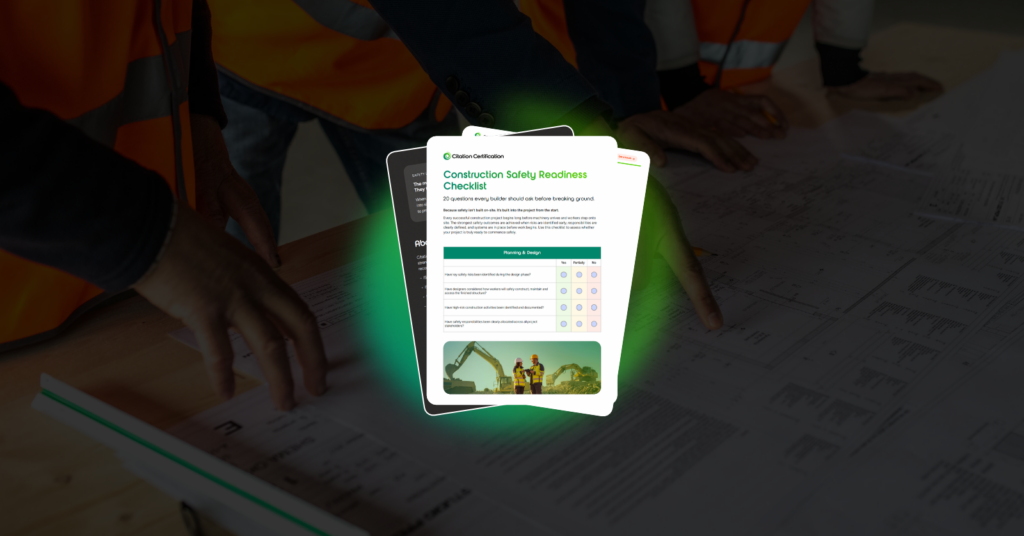
Safety isn’t built on site. It’s built into the project from the start — in...


Have your employees started submitting leave requests for December? Do your bar staff want to...


Nursing and care workers keep Australia’s health system running, and the work asks a lot...

Labour shortages. Multiple contractors and subcontractors. Tight deadlines. Client expectations. Compliance obligations across several sites...
ISO 14001 compliance means your organisation has implemented an EMS that meets the requirements of ISO 14001:2015 – the international standard for environmental management. A compliant EMS includes:
Being ISO 14001 compliant means your EMS meets all the requirements of ISO 14001:2015. In practice, that means you’ve identified your significant environmental aspects, documented your compliance obligations, set measurable environmental objectives, and put operational controls in place to manage your environmental risks. It also means you’re committed to continual improvement, with internal audits and management reviews to keep your EMS on track.
Compliant organisations can seek independent certification from a JAS-ANZ accredited body to verify and demonstrate that compliance to clients, regulators, and supply chain partners.
A compliance obligations register is a documented record of every legal requirement and voluntary commitment that applies to your organisation’s environmental aspects. Legal requirements include environmental legislation, permits, licences, and conditions set by regulatory agencies.
Voluntary commitments cover industry standards, codes of practice, and any environmental responsibilities your organisation has agreed to. The standard requires you to keep it current, use it to inform your planning and operational controls, and regularly evaluate your compliance status against it. It’s one of the foundations of a credible, auditable EMS, and where many organisations discover gaps during their initial gap analysis.
Many businesses use ‘compliance’ and ‘certification’ interchangeably. They aren’t the same.
For most Australian businesses, certification is the goal. It’s what gives your compliance credibility with clients, regulators, and supply chain partners.
Compliance obligations are the legal requirements and voluntary commitments that apply to your organisation’s environmental aspects. Legal requirements include applicable environmental legislation, permits, licences, and conditions set by regulatory agencies at federal, state, and local level.
Voluntary commitments include industry standards, codes of practice, contractual obligations, and any other environmental responsibilities your organisation has agreed to. You’re required to identify all applicable compliance obligations, document them in a compliance obligations register, and review that register regularly to ensure it remains current.
No. ISO 14001 is not mandated by Australian law, but it directly supports compliance with environmental regulations at federal and state level, including the Environment Protection and Biodiversity Conservation Act 1999, state environment protection acts, and applicable permit conditions.
For businesses in heavily regulated sectors, or those pursuing government contracts or enterprise supply chain relationships, ISO 14001 certification is increasingly expected as evidence of sound environmental management. It also gives you a clear, structured approach to demonstrating that your organisation manages its environmental responsibilities systematically.
For most businesses, ISO 14001 certification takes between six months and over a year from initial gap analysis to certificate issue. The exact timeframe depends on the size and complexity of your organisation, the maturity of your current environmental practices, and the scope of your EMS. Working with an experienced and accredited ISO 14001 certification company helps you move through the process efficiently and avoid common delays and dead ends.
ISO 14001 follows the Annex SL high-level structure, which it shares with ISO 9001 and ISO 45001. This means the three standards have a common framework for elements like leadership, planning, performance evaluation, and continual improvement. If your business already holds or is pursuing ISO 9001 certification, integrating ISO 14001 significantly reduces duplication of effort.
Integrated management systems bring quality, environmental, and safety requirements together in one streamlined framework. This improves operational efficiency and reduces the administrative burden associated with managing separate compliance programs.
Yes. ISO 14001 is a practical tool for uncovering cost savings across your operations. Systematically managing your environmental aspects almost always surfaces improvements in waste management, energy consumption, and resource efficiency that translate directly into reduced overheads.
Many organisations see measurable cost savings within the first year of ISO 14001 implementation. Beyond direct savings, ISO 14001 also reduces your regulatory and legal risk. When you weigh up ISO 14001 costs against those benefits, the case is clear.