









 HR & Safety Software
  ISO Training Academy
  foundU Client Login

Citation HR’s advice has been very helpful for us during this time. It’s also acting a solid source of teaching for me as I launch my HR career.
Stop guessing and start knowing. Our HR reporting software gives Australian businesses real-time workforce visibility, from headcount and leave liability to compliance gaps, so your HR team can stop reacting and start leading. When workforce data stays scattered across spreadsheets and folders, decisions get made on instinct and problems only surface after they’ve already cost you. The right HR management platform changes that. When your people data is clear, every risk gets spotted sooner, every decision gets easier, and HR becomes a function that drives the business forward.


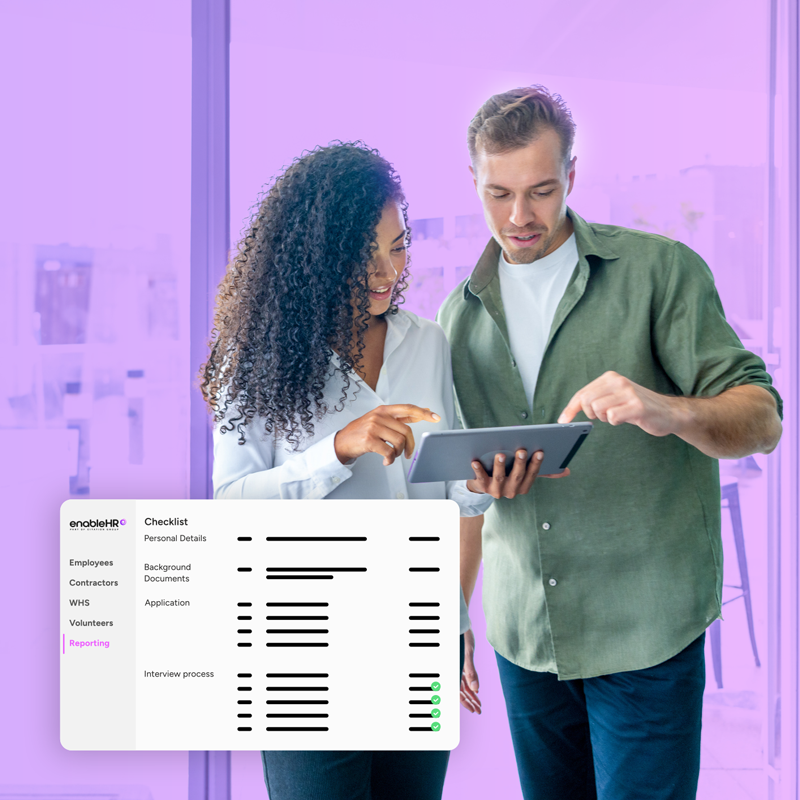
HR reporting software is a feature within your HRIS that collects, organises, and presents workforce data in dashboards and structured reports. It allows HR teams and business owners to monitor what’s happening across the employee lifecycle, identify trends, and make data-driven decisions, without building spreadsheets from scratch each time.
Good HR analytics tools go further than summary counts. They surface patterns: rising employee turnover in a particular team, leave liability that’s quietly accumulating, certification gaps that could create a compliance risk. That’s the difference between HR admin and strategic HR work.





Citation HR’s advice has been very helpful for us during this time. It’s also acting a solid source of teaching for me as I launch my HR career.
The support we have had from Citation Group during our restructure program has been outstanding. Having a dedicated industrial support means it has taken a lot of the emotion out of a restructuring project that needed to happen, allowing us to put in a process-driven approach.
Having completed that project we continue to receive excellent ongoing support and value from Citation HR. I’m pretty much a fan. I recommend Citation Group to a lot of people as well.

Whether we just need to confirm something or if we think there’s a bigger problem on our hands, we know that we’ll get an expert on the line every time and that we’re getting industry-leading guidance and advice.

Citation HR feels like they’re the HR department of our business, and is flying a flag for us. We’ve found Citation HR is super supportive, super helpful, super timely and they share our values.

Citation HR’s software’s scalable technology means it’ll grow with us, no matter how big or small we get – its platform can be optimised to suit us and gives us the tools and support we need so that we can continue to deliver stellar cleaning and customer service to our clients.

If you’re not in the HR space, and that’s not where your skill set lies, you’ve got to use Citation HR. In the franchising world it’s so easy to do something incorrectly, even if it’s not on purpose. The costs, fines, and penalties are so high. You’ve got to have that correct advice and that support. Citation HR has totally supported our franchisees with any compliance concerns. The outcome was fantastic.
Our HR tool supports detailed reports across the entire employee lifecycle. As with all HR management platforms, the value comes from having your full suite of people data in one place, so nothing stays hidden in a folder or a spreadsheet.






HR reporting without compliance context is just numbers. Our platform is built specifically for Australian businesses, so the reports your team generates are grounded in the employment law obligations that actually apply to you.
Under the Fair Work Act, employers are required to maintain accurate records of hours worked, leave entitlements, and each employee’s pay. Our system keeps those records current, structured, and exportable at any time.
For businesses covered by modern awards, having a clear audit trail of employee management decisions, entitlements, and documentation isn’t optional – it’s essential. Our reporting layer gives you that trail as a by-product of everyday HR operations, not as a separate compliance project.
Our local team of HR professionals and employment lawyers backs the platform. When a report surfaces a potential gap, or when you need to ensure compliance before a specific event, expert advice is available – not just a help article.
HR reporting software is a feature within an HR management system that collects, organises, and presents workforce data in structured reports and dashboards. It allows HR professionals and business owners to track headcount, monitor employee turnover, manage leave, run compliance checks, and make data-driven decisions without manually compiling data from separate sources. Unlike a general HRIS, HR reporting software is specifically focused on surfacing insights from your employee data so your HR team can act on it.
Australian employment law requires employers to maintain accurate records across the entire employee lifecycle, from contracts and inductions through to leave balances and terminations. HR reporting software gives you detailed reports on documentation completeness, leave entitlements, and HR processes, so you can identify gaps before a Fair Work audit or dispute arises. Having an accessible audit trail is particularly important for businesses covered by modern awards, where entitlement records need to be current and accurate at all times.
You can run detailed reports covering workforce headcount and structure, employee turnover and tenure, leave balances and liability, onboarding and contract completion, training and certification status, and performance review activity. Reports can be filtered by team, location, employment type, or date range, and exported for leadership or compliance purposes. Our cloud HR platform is user-friendly – you don’t need a data analyst to get the numbers you need.
Our HR software handles HR reporting and workforce analytics across the employment lifecycle. For payroll processing, pay cycle data, and payroll reporting including STP Phase 2 compliance, we offer foundU, our dedicated payroll software platform. Many Citation Group clients use both. Talk to our team about getting the full picture across HR and payroll.
Yes, in a positive way. When employees use the employee self-service portal to submit leave requests, update their own information, or complete tasks, that data flows directly into your reporting engine. The more your team engages with the platform, the more accurate and complete your HR analytics become. It also reduces manual data entry, which typically leads to errors in HR admin records.