







 HR & Safety Software
  ISO Training Academy
  foundU Client Login



Our most recent audit cycle was one of the most positive experiences we’ve had since certifying to ISO/IEC 27001:2022, and the relaxed nature allowed us to engage in discourse that was open and honest about gaps and our plans to fix them.
Australian businesses supported
Workplace advice calls every year
Our customers are 5× less likely to face a Fair Work tribunal claim
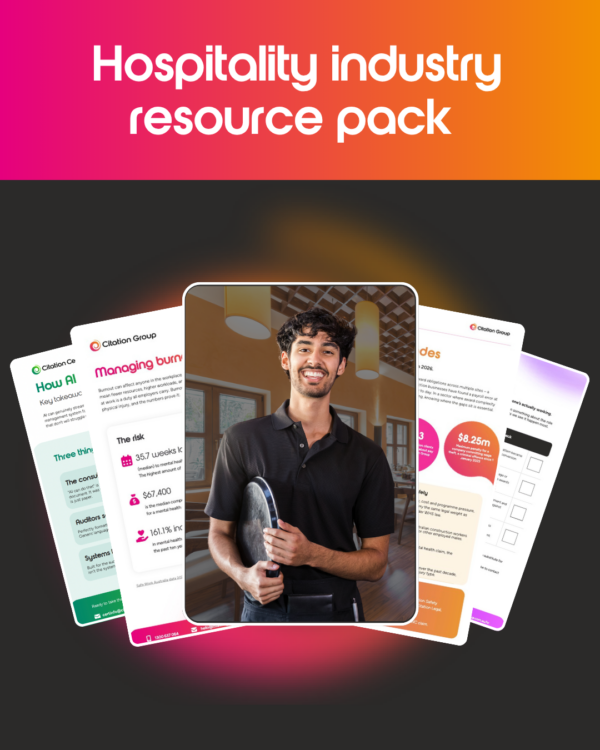
This pack brings together nine resources for hospitality businesses on the areas that matter most day-to-day: employment contracts, junior pay rates, food safety compliance, and workplace psychosocial risk, alongside the latest sector data from the Fair Work Ombudsman. Download the pack to see where the common compliance gaps sit for hospitality businesses, and what’s worth reviewing first.
Between the Hospitality Industry (General) Award, WHS duties, and staff turnover, there’s a lot to stay across. And the regulatory environment has shifted significantly in the past two years. Here’s what you’re up against.


The Hospitality Industry (General) Award is consistently among the most misapplied in the Fair Work system. Our legal experts see hospitality as one of the sectors where compliance is most often built around industry norms rather than actual Award obligations. With wage theft now a criminal matter, that gap carries consequences it didn't before. These are the provisions our advisors are asked about most.
Penalty rates under the Hospitality Award aren't flat. They step up depending on the day, classification, and employment type, with Sunday rates higher than Saturday rates, and public holiday rates higher again. Overtime applies to hours worked beyond ordinary hours. In a venue running seven days and late nights, these provisions fire almost every week. What catches operators out is the compounding effect: a team of ten casuals over a long weekend each attracts different combinations of penalty rates, overtime and casual loading across potentially multiple classifications. Calculated incorrectly across a year of trading, the backpay exposure is significant, and the FWO's targeted hospitality campaigns are designed to find it.
A common mistake we see: treating Saturday rates as optional if staff agree, or failing to track overtime correctly when staff clock on early or finish late.
Our HR advisors review your current pay arrangements against Hospitality Award obligations, identify exposure and help you implement compliant systems before issues escalate.
CALL THE ADVICE LINEHR support, payroll software, WHS consulting, and ISO certification – one team, one point of contact, no gaps.

Sector specialists available 24/7, backed by Citation Legal. No call limits, no time caps.

Rostering, payroll and onboarding in one platform, built for Award-driven hospitality environments, not bolted together after the fact.

Practical, auditable safety systems built for how hospitality workplaces operate. From kitchen hazards and manual handling to fatigue, customer aggression and psychosocial risks, we help hospitality businesses identify risks, meet their WHS obligations and build safer workplaces. Our 2026 Workforce Pulse survey found 89 per cent of businesses feel confident about physical safety, compared with 77 per cent for psychosocial risk, highlighting a common gap in hospitality safety management.

Signal to corporate clients, franchise partners and procurement teams that your operation meets internationally recognised standards, and your food safety legal obligations at the same time.
HR, payroll, safety and ISO work better when they're connected. We bring it all together in one place, improving visibility, reducing compliance risk and eliminating system silos. Our 2026 Workforce Pulse survey found 58 per cent of Australian businesses still operate fragmented systems.

HR advice, hospitality payroll software, workforce management, safety consulting and ISO certification, all from Citation Group. No duplicate data entry or explaining your situation from scratch to three different providers.
Our HR advisors understand the Hospitality Award. Our WHS consultants know the difference between a fast-casual restaurant environment and a multi-level hotel operation. This isn't generic HR software for hospitality with an industry badge on it – it's built from the ground up for operators like you.
When the Award changes, your payroll gets updated. When a disciplinary issue arises, your HR advisor and your documentation system are aligned. That's what having a genuine business partner looks like, not just a helpdesk.
Our most recent audit cycle was one of the most positive experiences we’ve had since certifying to ISO/IEC 27001:2022, and the relaxed nature allowed us to engage in discourse that was open and honest about gaps and our plans to fix them.

The auditor that was assigned to us was fantastic. He explained what was expected and required before the audit commenced. And even during the audit process, when things were being identified or uncovered, we could work quite dynamically. He was really accommodating and professional, and really quite pragmatic in the recommendations for improvement, which we’ve taken on board.

The collaborative relationship we’ve developed with Citation Certification has turned into a true partnership where our business needs are holistically understood and supported.


Citation HR feels like they’re the HR department of our business, and is flying a flag for us. We’ve found Citation HR is super supportive, super helpful, super timely and they share our values.

Citation HR’s software’s scalable technology means it’ll grow with us, no matter how big or small we get – its platform can be optimised to suit us and gives us the tools and support we need so that we can continue to deliver stellar cleaning and customer service to our clients.




Under the Hospitality Industry (General) Award 2020, penalty rates apply to all ordinary hours worked on Saturdays, Sundays and public holidays. Saturday rates are higher than ordinary weekday rates; Sunday rates are higher again; public holiday rates are the highest under the Award. The exact percentage depends on each employee’s classification and whether they are full-time, part-time or casual.
Casual employees receive their casual loading and the applicable penalty rate – both apply separately. A common error is paying only the casual loading on weekends without also applying the weekend penalty rate, resulting in an underpayment liability.
Yes. foundU supports multi-site hospitality operators from a single platform, with venue-specific rostering rules, shift structures, and managers, sitting alongside centralised payroll, Award interpretation, and reporting.
The platform automatically applies the Hospitality Industry (General) Award 2020, including penalty rates, overtime, and casual loadings, so that pay calculations are consistent across all sites, regardless of which manager builds the roster. Approved timesheets flow directly into payroll, removing the manual step where underpayment errors most commonly occur.
Hospitality businesses in Australia have a legal duty of care under the Work Health and Safety Act 2011 to ensure the health, safety and welfare of all workers, so far as is reasonably practicable. This duty applies to employers in their capacity as a ‘Person Conducting a Business or Undertaking’ (PCBU).
In practice, this requires identifying and controlling hazards specific to hospitality – kitchen risks (burns, cuts, slips, heat stress), manual handling, customer aggression, shift fatigue and noise. Employers must also maintain WHS records, investigate incidents, and report notifiable incidents to the relevant state regulator.
Both ISO certification and HACCP are relevant to hospitality operators and serve different purposes.
Four areas require attention:
A brief conversation with one of our specialists is all it takes to understand where you stand and what to do next. No obligations, just practical advice from people who know hospitality.