







 HR & Safety Software
  ISO Training Academy
  foundU Client Login



Our most recent audit cycle was one of the most positive experiences we’ve had since certifying to ISO/IEC 27001:2022, and the relaxed nature allowed us to engage in discourse that was open and honest about gaps and our plans to fix them.
Australian businesses supported
Workplace advice calls received each year via our Advice Line
HR Audits conducted, uncovering and solving thousands of workplace risks
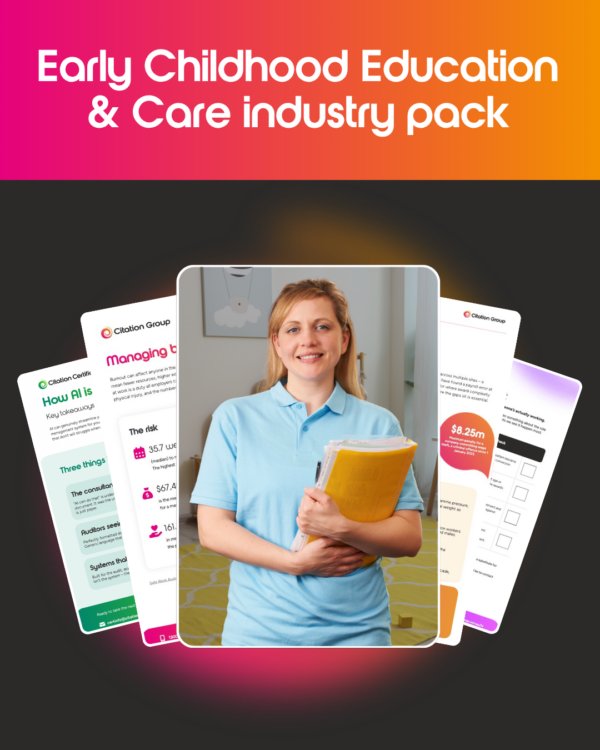
Early childhood and childcare providers are juggling ratio requirements, back-to-back Award changes, and a workforce that’s often casual or seasonal – on top of everyday HR and safety obligations. This pack brings together seven resources covering the areas that matter most for the sector. From contracts and recruitment to redundancy and the pay and compliance changes reshaping childcare. This pack is a practical way for early childhood providers to get a clearer picture of where they stand.
Between the Children’s Services Award, staff-to-child ratios, Working with Children Checks, qualification requirements under the National Quality Framework and CCS attendance obligations, it’s a lot to stay across. And 2026 has made it more complex, not less. According to Citation Group’s 2026 Workforce Pulse, 97 per cent of business leaders surveyed feel confident managing their workforce responsibilities, yet 42 per cent have found a payroll error at some point, and 44 per cent have no clear approach to people management. Here’s what you’re up against.


From 1 March 2026, the Children's Services Award moved to a new eight-level classification structure, replacing the previous structure of 36 minimum pay rates, following a Fair Work Commission finding that the award had undervalued its largely female workforce. Rates are rising in stages through to 2028-29, on top of annual wage review increases.
Every existing employee needs to be correctly translated into the new structure based on their actual qualifications and duties, not simply carried across at the old equivalent level. Providers on the Worker Retention Payment also need to recalculate the top-up as award rates change, so combined pay never falls short.
Broken shift, first aid, higher duties and Educational Leader's Allowances still apply on top of base rates.
A common mistake we see: Translating existing staff into the new eight-level structure without reassessing their actual qualifications and duties is one of the fastest-emerging sources of underpayment risk in the sector this year.
Our HR advisors review your current pay arrangements against the new Children's Services Award classification structure, check your ratio and WWCC tracking, and help you implement compliant systems before issues escalate. Call the advice line any time – no time limits, no extra charge.
CALL THE ADVICE LINEOne place for HR consulting, workforce management and payroll, WHS consulting and ISO certification. No handoffs, no gaps – just one team who understands your sector.

Sector specialists available 24/7, backed by Citation Legal. No call limits, no time caps.

Rostering, payroll and onboarding in one platform, built for ratio-driven, qualification-dependent environments.

Practical, auditable safety systems that meet your obligations under work health and safety laws, built around the realities of working with children.

Signal to families, funding bodies and corporate partners that your service operates to a recognised standard. Increasingly relevant as more providers expand across multiple sites and enter government-funded or corporate procurement arrangements.
Unlike providers that handle HR advisory, payroll software, safety consulting or ISO certification in isolation, Citation Group combines all four. Here's what that means for your service.

HR advice, workforce software, safety consulting and ISO certification – all from Citation Group. No handoffs, no gaps, no starting from scratch with a new provider.
Our advisors track changes to the Children's Services Award as they occur and understand ratio and WWCC obligations. This isn't generic compliance support with an early childhood skin on it.
When the Award changes, your payroll gets updated. When a ratio gap or a WWCC expiry arises, your advisor and documentation are aligned.
Our most recent audit cycle was one of the most positive experiences we’ve had since certifying to ISO/IEC 27001:2022, and the relaxed nature allowed us to engage in discourse that was open and honest about gaps and our plans to fix them.

The auditor that was assigned to us was fantastic. He explained what was expected and required before the audit commenced. And even during the audit process, when things were being identified or uncovered, we could work quite dynamically. He was really accommodating and professional, and really quite pragmatic in the recommendations for improvement, which we’ve taken on board.

The collaborative relationship we’ve developed with Citation Certification has turned into a true partnership where our business needs are holistically understood and supported.


Citation HR feels like they’re the HR department of our business, and is flying a flag for us. We’ve found Citation HR is super supportive, super helpful, super timely and they share our values.

Citation HR’s software’s scalable technology means it’ll grow with us, no matter how big or small we get – its platform can be optimised to suit us and gives us the tools and support we need so that we can continue to deliver stellar cleaning and customer service to our clients.




From the first full pay period on or after 1 March 2026, the Fair Work Commission replaced the award’s previous classification structure of 36 minimum pay rates with a new, simplified eight-level system, following a finding that the award had historically undervalued its largely female workforce. Minimum rates are increasing in stages, with further adjustments on 30 June each year through to 2028 or 2029. Providers need to correctly translate every existing employee into the new structure based on their actual qualifications and duties, and recheck any Worker Retention Payment top-ups whenever the underlying award rate changes, so combined pay doesn’t fall below the required threshold.
Ratios and qualification mix requirements under the Education and Care Services National Law apply continuously, not just during core hours, which makes rostering one of the highest-risk areas for compliance failure. foundU’s rostering software is built to match educators to rooms based on qualifications and ratio requirements, not just availability, and flags gaps before a shift starts. Alongside this, our HR advisors help you build documented processes for tracking qualifications, Working with Children Checks and first aid certifications so nothing lapses unnoticed.
Under work health and safety laws, ECE providers must identify and manage both physical and psychosocial hazards, including manual handling risks from lifting and physical care tasks, incident and injury management involving children, and the psychosocial risks associated with high-responsibility, emotionally demanding work. Having a policy folder or an Employee Assistance Program in place is not the same as an active risk management system – the legal obligation is to identify hazards, assess the risk, implement controls and review them regularly.
It depends on your growth plans, but it’s becoming more relevant. As more ECE providers consolidate into multi-site groups or pursue government-funded and corporate partnership arrangements, ISO 9001 (quality management) and ISO 45001 (safety management) increasingly demonstrate to funders, corporate partners and regulators that your systems are independently verified rather than self-assessed. It’s not yet a blanket requirement across the sector, but providers pursuing scale or public funding are seeing it requested more often.
Yes. foundU combines rostering, timesheets and payroll in one platform, with Children’s Services Award interpretation built in and kept current as the award’s classification structure and rates change. It rosters educators against ratio and qualification requirements in real time, captures Working with Children Check and qualification expiry dates with automatic alerts, and processes Single Touch Payroll (STP2) compliant pay runs directly from approved timesheets – removing the manual handoffs where underpayment and ratio breaches typically occur.
A brief conversation with one of our specialists is all it takes to understand where you stand and what to do next. No obligation, just straightforward advice from people who know this sector.
We help you make sense of it and put the right systems in place.