







 HR & Safety Software
  ISO Training Academy
  foundU Client Login
Blogs
Brittany Byrne named finalist in the 2026 Lawyers Weekly Women in Law Awards
Brittany Byrne recognised as a finalist in the Mentor of the Year category.
15 October, 2026
 Blogs
2 September, 2026
Blogs
2 September, 2026

Australia’s nursing, care and support workforce keeps the health system running – yet it’s also one of the most physically and psychologically demanding areas of work in the country. New data from Safe Work Australia paints a clear picture of where the risks sit, and why employers in this sector can’t treat safety as a background issue.
More than 657,000 people work across roles including registered nurses, aged and disabled carers, nursing support and personal care workers, enrolled and mothercraft nurses, and midwives. Together, Safe Work Australia groups these roles as the “nursing, care and support workforce” because they share similar job demands, even though the settings and required skills differ.
This workforce looks different to the broader labour market in several ways. It’s 85.2 per cent female, compared with 48 per cent across all occupations. And workers put in longer hours (42 a week on average, against 38 for all occupations). With long working hours and a majority female workforce, employers in this industry should be on the lookout for signs of burnout in staff and have processes in place for reporting and controlling sexual harassment of workers.
Safe Work Australia’s compensation data shows the nursing, care and support workforce has recorded a serious claims frequency rate 2.3 times the national average for musculoskeletal injuries in 2022–23. Body stressing (muscular strain from handling, lifting or positioning patients) has been the leading cause of serious claims for more than a decade, accounting for an average of 47.6 per cent of all serious claims in this workforce, compared with 37.8 per cent across all occupations.
A striking feature of this data is who – or what – causes the injury. Over half (54.5 per cent) of body stressing claims in this workforce cite a “human agency” as the direct cause, compared with just 12.8 per cent across all other occupations. More than one in three of those claims involve a patient or resident in care, typically during a manual handling task that results in musculoskeletal injury.
Claims involving muscular stress while handling objects are also the most costly. Median time lost runs 2.6 weeks longer than the average for other injury types, and median compensation payments are $3,609 higher.
The data also confirms what many in the sector already know: workplace violence is a routine hazard, not an occasional one. Health care and social assistance workers report higher rates of bullying than the all-industry average (31 per cent versus 29 per cent), and markedly higher exposure to aggressive behaviour – 50 per cent report angry or hostile behaviour, 41 per cent report shouting and swearing, and 35 per cent report intimidation and insults.
The frequency rate of serious claims from being assaulted is around 6.5 times higher for this workforce than for all other occupations, and that gap has widened over the past decade.
Reporting processes matter as much as the controls themselves. Staff need clear, confidential channels to report violence or aggression without fear of it affecting how they’re viewed or treated at work.
Training should cover when it’s appropriate to remove themselves from an unsafe situation, with clear reassurance that doing so won’t result in being reprimanded.
Serious claims for mental health conditions have nearly doubled over the last 10 years, adding more than 500 additional serious claims to the total. Anxiety and stress disorders, reactions to stressors, and post-traumatic stress disorders together account for 82 per cent of these claims. Given that many people experiencing poor mental health don’t seek treatment, particularly in a workplace context, the true scale of the issue is likely understated in the data.
Under work health and safety laws, a person conducting a business or undertaking (PCBU) has a duty to identify hazards, assess risks, and put effective controls in place to protect workers. For organisations in aged care, disability support, hospitals and community health, this data points to three areas worth close attention:
Navigating these priority areas at once is a lot to manage on top of running a business. Citation Safety gives businesses the tools, advice and support to build genuine, demonstrable safety practices.
From WHS audits and gap assessments through to our digital WHS Software platform and around-the-clock Safety Advice Line, we help businesses know where they stand – with practices that hold up under scrutiny, not just on paper.
If your business operates in a high-risk sector, or you’re not sure where the gaps are, get in touch with our team for a confidential conversation about what needs to happen next.
Brittany Byrne recognised as a finalist in the Mentor of the Year category.

Safety isn’t built on site. It’s built into the project from the start — in...


Have your employees started submitting leave requests for December? Do your bar staff want to...
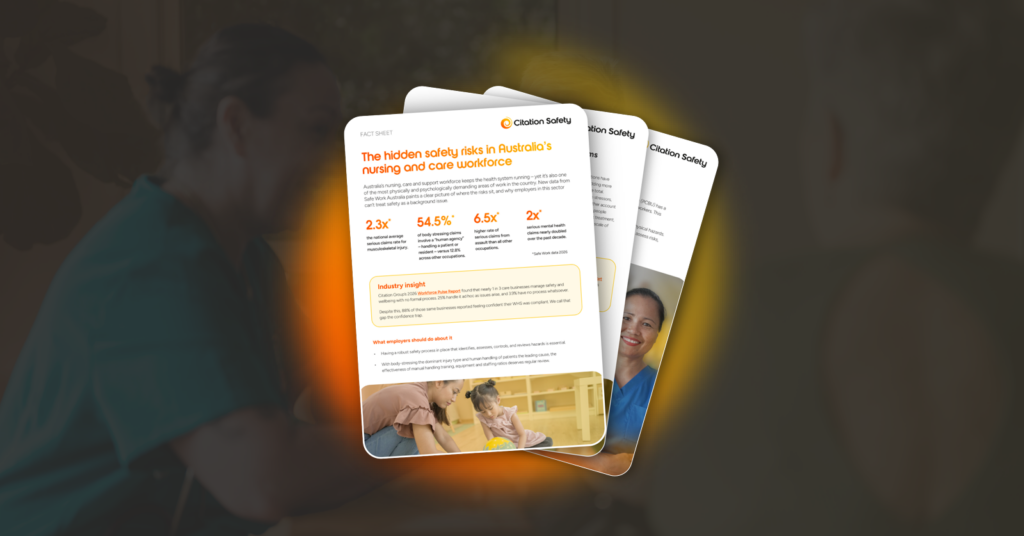
Nursing and care workers keep Australia’s health system running, and the work asks a lot...

Labour shortages. Multiple contractors and subcontractors. Tight deadlines. Client expectations. Compliance obligations across several sites...